Green Business
The 2am Problem: How AI's Energy Appetite Is Exposing Sustainability's Biggest Lie
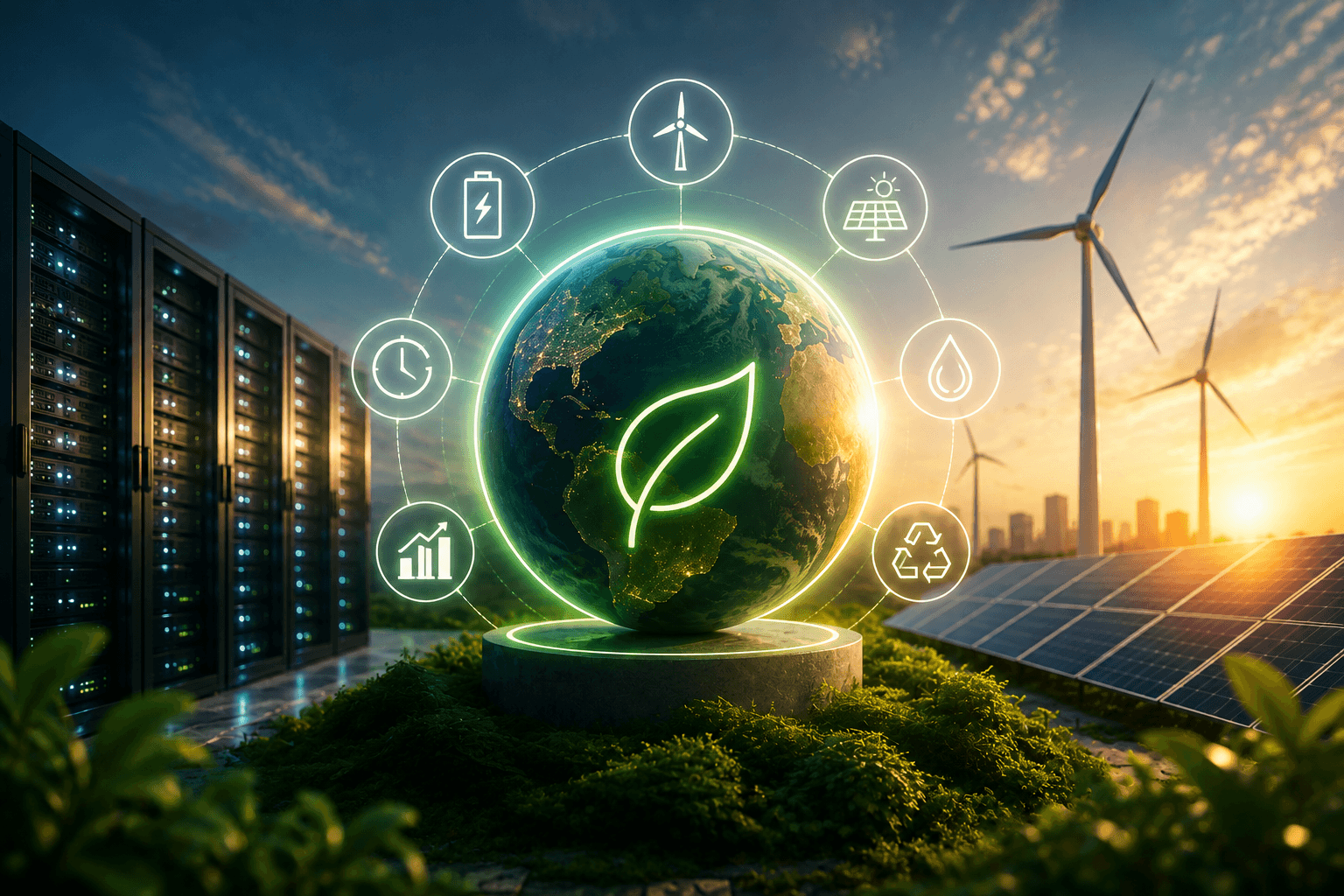
For the last decade, corporate sustainability ran on a simple accounting trick: use grid power when you need it, then buy enough renewable energy credits over the course of the year to "offset" it. A data center running at 2am on coal-heavy grid power could still claim to be "100% renewable" because a solar farm somewhere generated an equivalent amount of clean energy at noon, on a different day.
That model is now collapsing under its own weight. And the reason is AI.
Why AI Changed the Math
AI workloads don't run on a 9-to-5 schedule. Training runs and inference demand pull power around the clock, and the scale is staggering data center electricity demand is one of the fastest-growing loads on national grids right now. That constant, high-volume draw has exposed the flaw in annual offsetting: it was never designed to answer the question that actually matters, which is what was powering this specific server, at this specific hour?
Regulators, investors, and enterprise customers are starting to ask exactly that question. And "we bought enough solar credits in June" isn't a satisfying answer anymore.
Enter 24/7 Carbon-Free Energy (CFE)
The standard emerging to replace annual offsetting is called 24/7 Carbon-Free Energy — matching actual consumption to actual clean generation, hour by hour, rather than netting it out over 12 months. Under a 24/7 CFE model, a facility running overnight needs to show it was drawing from wind, hydro, nuclear, or stored renewable power during that window not from a solar credit generated hours earlier when the sun happened to be out.
This is a meaningfully harder standard to meet. It requires:
Granular, hourly energy data — not monthly or annual summaries
Real-time tracking infrastructure that can attribute consumption to generation source as it happens
New verification instruments — often referred to as granular certificates, that can prove the match stands up to scrutiny
Smarter procurement, blending storage, diverse renewable sources, and demand flexibility to actually hit round-the-clock coverage
For any business managing energy-intensive infrastructure not just hyperscale data centers, but manufacturing sites, EV fleets, and distributed operations this is the direction the entire market is moving.
How Hourly Matching Actually Works
The mechanics of 24/7 CFE are a genuine departure from how most companies currently report on energy, so it's worth breaking down what changes in practice.
Under the old model, a company would total up its annual electricity consumption, then purchase Renewable Energy Certificates (RECs) equal to that volume, generated anywhere on the grid, at any time of year. The certificate proved that somewhere, at some point, an equivalent amount of clean power was produced. It said nothing about whether that power was actually available when the company's operations needed it.
Hourly matching removes that flexibility. Every hour of consumption has to be paired with an hour of matching clean generation, ideally from a source physically capable of serving that grid at that time. This typically means:
Time-stamped generation data, not annual totals, tracked at the source
Time-stamped consumption data, tracked at the facility or even at the rack level for data centers
A settlement or certificate layer that reconciles the two and flags any hours where the match falls short
A storage and flexibility strategy to cover the inevitable gaps, the hours when wind or solar generation dips but demand doesn't
That last point is where things get genuinely difficult. Solar doesn't generate at 2am. Wind isn't reliable on demand. So companies pursuing serious 24/7 CFE targets are increasingly pairing renewable generation with battery storage, demand-response contracts, and diversified generation portfolios (wind plus solar plus hydro plus, in some cases, nuclear) specifically to smooth out the hours that pure renewables can't cover alone.
The Market Is Already Moving, Not Just Talking
This isn't a theoretical framework being debated in sustainability conferences. It's already showing up in how capital moves. Sustainable investing continues to command trillions in assets under management, and critically, investor and regulator patience for unverified claims is shrinking fast. Hundreds of greenwashing-related enforcement actions have already been logged globally this year alone, a sharp signal that "sustainability marketing" without underlying data is now a liability, not just a missed opportunity.
At the same time, the businesses driving the biggest energy procurement decisions — the hyperscalers and large data center operators — are the ones setting the pace on 24/7 CFE adoption. When the largest buyers in a market start demanding a new standard from their energy suppliers, that standard has a way of cascading down through the entire supply chain, including to mid-market operators who source power, or sell into, the same grids and ecosystems.
What This Looks Like in Practice
Picture two companies running similar energy-intensive operations — say, a distributed network of facilities with significant overnight processing loads.
Company A reports its sustainability performance annually. It buys enough renewable credits each year to offset its total consumption and publishes a clean figure in its ESG report: "100% renewable energy." On paper, that looks strong. But when a major enterprise client's procurement team asks for hour-by-hour generation data to verify the claim, Company A has no way to produce it. The client, increasingly wary of greenwashing exposure of its own, moves the contract to a competitor who can.
Company B, by contrast, has already invested in real-time energy monitoring across its facilities. It can show, hour by hour, where its power came from — including the specific hours it fell short of a full clean match, and the storage and procurement strategy it's using to close that gap over time. It's not perfect. But it's transparent, verifiable, and improving. That's the version of sustainability that survives regulatory and procurement scrutiny going forward.
The difference between these two companies isn't ambition. It's infrastructure.
Why This Matters Beyond the Data Center Industry
It's tempting to file this under "someone else's problem" if you're not running AI training clusters. But the shift has knock-on effects for any B2B company touching the energy supply chain:
Procurement standards are tightening. Enterprise buyers increasingly want to see hourly-matched clean energy claims from vendors, not just an annual renewable percentage on a sustainability report.
Greenwashing enforcement is rising sharply. With hundreds of greenwashing-related enforcement actions already recorded globally this year, vague or unverifiable sustainability claims carry real legal and reputational risk — not just brand risk.
The technology gap is becoming a competitive gap. Businesses that already have real-time energy monitoring and intelligent load management in place are simply better positioned to meet 24/7 CFE-style standards when clients or regulators start asking. Those still operating on annual, offset-based reporting will find themselves scrambling to retrofit visibility they should have built years ago.
Getting Started: A Practical Roadmap
Moving toward hourly-matched clean energy doesn't happen overnight, and no business is expected to hit a perfect 24/7 CFE score on day one. Companies that are ahead of the curve tend to work through a similar sequence:
Establish visibility first. Before anything else, you need to know what you're actually consuming, and when. This means deploying real-time monitoring at the facility level rather than relying on monthly utility bills, which simply don't have the resolution to support hourly analysis.
Baseline your current match rate. Once consumption data exists at the hourly level, it can be compared against the generation mix of your grid at each hour, giving you an honest starting percentage — not the flattering annual number, but the real, hour-by-hour figure.
Identify your biggest gap hours. For most businesses, the largest shortfalls cluster around specific windows — often overnight or during seasonal lulls in renewable generation. Knowing exactly when the gaps occur makes it possible to target solutions instead of over-investing across the board.
Layer in storage and flexible procurement. Battery storage, demand-response participation, and diversified power purchase agreements are the tools most commonly used to close identified gaps, generally in that order of cost-effectiveness for mid-market operators.
Report transparently, including the shortfalls. Counterintuitively, publishing an honest 80% hourly match with a clear plan to close the remaining gap builds more credibility with investors, regulators, and enterprise clients than a vague 100% annual claim that can't be independently verified.
This sequence also happens to mirror where most of the current tooling investment in the green business space is going: monitoring first, intelligent management second, storage and flexible procurement third. Businesses that build the monitoring and data layer now are the ones with the option to move quickly once regulatory or client pressure arrives — rather than starting that build from zero under a deadline.
The Takeaway
The AI boom didn't just create a demand problem for power grids — it exposed how thin the old sustainability accounting really was. Hourly-matched, verifiable clean energy is quickly becoming the new baseline expectation, not a future ambition.
Businesses that invest now in real-time energy monitoring and intelligent management systems won't just be ready for where regulation and enterprise procurement are heading. They'll be the ones setting the standard everyone else has to catch up to.
Want to understand where your energy infrastructure stands against the 24/7 CFE standard? Get in touch with our team to explore the right monitoring and management tools for your business.
© Copyright 2025, All Rights Reserved
Privacy Policy
Terms & Conditions
